
Quick answer
Breast reconstruction surgery is an operation to rebuild a breast mound following mastectomy. It can be performed at the same time as your mastectomy (immediate reconstruction) or at a later date (delayed reconstruction).
Both implant-based and flap-based techniques are available, and the right choice depends on your oncology plan, body type and personal priorities.
Key takeaways
- Both immediate and delayed breast reconstruction are clinically valid options, and the timing decision is guided by your cancer treatment plan and personal circumstances.
- Two main techniques are available: implant-based reconstruction and autologous (flap) reconstruction using your own tissue, most commonly DIEP flap.
- The decision should be made with your specialist team, taking into account your oncology team’s recommendations, your body type, recovery goals and what matters most to you.
- Reconstruction does not affect the outcome of your cancer treatment or increase the risk of recurrence, and it is recommended in national guidance that reconstruction is discussed with everyone offered a mastectomy.
- Results take 12 to 18 months to fully settle and some patients benefit from minor revision surgery after this period.
- You do not have to decide immediately, and it is important to take your time to consider your options carefully.
Facing a mastectomy is one of the most frightening things a person can go through. If you are reading this, you may have just received a diagnosis, be in the early stages of planning treatment, or be trying to process a conversation you were not expecting to have.
Breast reconstruction surgery is not a requirement and some patients choose not to have it, which is an equally valid decision, but for many women knowing that reconstruction is possible and understanding exactly what it involves makes the prospect of mastectomy far less overwhelming.
What is breast reconstruction?
Breast reconstruction is a surgical procedure (or series of procedures) that rebuilds a breast mound following the removal of breast tissue during mastectomy, and the goal is to restore breast shape and, in many cases, symmetry with the opposite breast.
It is important to be honest about what reconstruction can and cannot achieve. Reconstruction creates a breast mound, but it is not the same as your original breast. Sensation in the reconstructed breast is often altered or absent, though this can gradually improve over time, particularly with certain techniques. The appearance and feel of a reconstructed breast is generally very good, but results take 12 to 18 months to fully settle, and some patients benefit from additional minor procedures such as nipple reconstruction or contralateral breast adjustment once the main reconstruction has healed.
Reconstruction is performed by a consultant plastic or oncoplastic breast surgeon, often working alongside your breast cancer surgeon, and it can be discussed as part of your overall breast cancer treatment plan from the outset to enable you to have the information you need to make an informed decision without feeling rushed.
Immediate versus delayed breast reconstruction: which is better?
There is no universally correct answer to this question. Both approaches have real advantages, and the right choice depends on a combination of clinical and personal factors.
Immediate reconstruction
Immediate reconstruction takes place at the same time as your mastectomy, under the same anaesthetic. The advantage is that you wake from surgery with a breast shape already in place, which many patients find less distressing, and it also tends to produce better cosmetic results because the skin envelope is preserved.
Immediate reconstruction however is not always the right option. If you need radiotherapy after your mastectomy, this can affect the reconstructed tissue and implants, and radiotherapy to an implant significantly increases the risk of capsular contracture and poor cosmetic outcomes. In those cases, delaying reconstruction until radiotherapy is complete is often the more sensible clinical choice.
Delayed reconstruction
Delayed reconstruction is performed weeks, months or even years after the original mastectomy. It allows you to complete cancer treatment (chemotherapy, radiotherapy or both) before undergoing reconstruction. It also gives you more time to research your options, process the diagnosis and make a decision that feels right for you.
Delayed reconstruction does mean living without a breast mound for a period of time, which some patients find difficult. Prostheses and specialist bras can help during this time. The cosmetic outcome of delayed reconstruction can be excellent, although the surgical technique may differ slightly from immediate reconstruction.
“What I tell patients when we discuss timing is that there is no single right answer, and that the best decision is the one that fits your cancer treatment plan and your life. Some of my patients come to me already certain about what they want; others need several conversations before they feel ready to decide.”
Mr Debashis Ghosh, Consultant Breast and Oncoplastic Surgeon
Implant-based breast reconstruction
Implant-based breast reconstruction uses a silicone or saline breast implant to recreate the breast mound. It is the most commonly performed type of breast reconstruction and is generally the less complex surgical option.
There are two main approaches within implant-based reconstruction:
Tissue expander followed by implant
A tissue expander is a temporary, adjustable implant placed under the chest muscle at the time of mastectomy. Over the following weeks and months, saline is gradually added to stretch the skin and create a pocket of the right size and shape. Once expansion is complete, a second operation replaces the expander with a permanent implant. This staged approach is very common and allows for careful shaping of the final result.
Direct-to-implant (one-stage) reconstruction
In selected patients (particularly those undergoing skin-sparing or nipple-sparing mastectomy), it may be possible to place a permanent implant in a single procedure without the expander stage. This is only suitable where there is sufficient skin and soft tissue remaining, and where the size requirements are not too large. A mesh (acellular dermal matrix or synthetic mesh) is often used to support the implant.
Implants have a finite lifespan of typically 10 to 20 years, so you may need further surgery at some point in the future to replace them.
Radiotherapy to the reconstructed area increases the risk of complications such as capsular contracture (scar tissue forming around the implant) and this is a key consideration when deciding between implant and flap reconstruction.
Autologous (flap) breast reconstruction: DIEP and other options
Autologous reconstruction uses your own tissue, taken from another part of the body, to create a new breast. The tissue used is called a flap. The most commonly performed flap technique is the DIEP flap, though several other options exist.
DIEP flap reconstruction
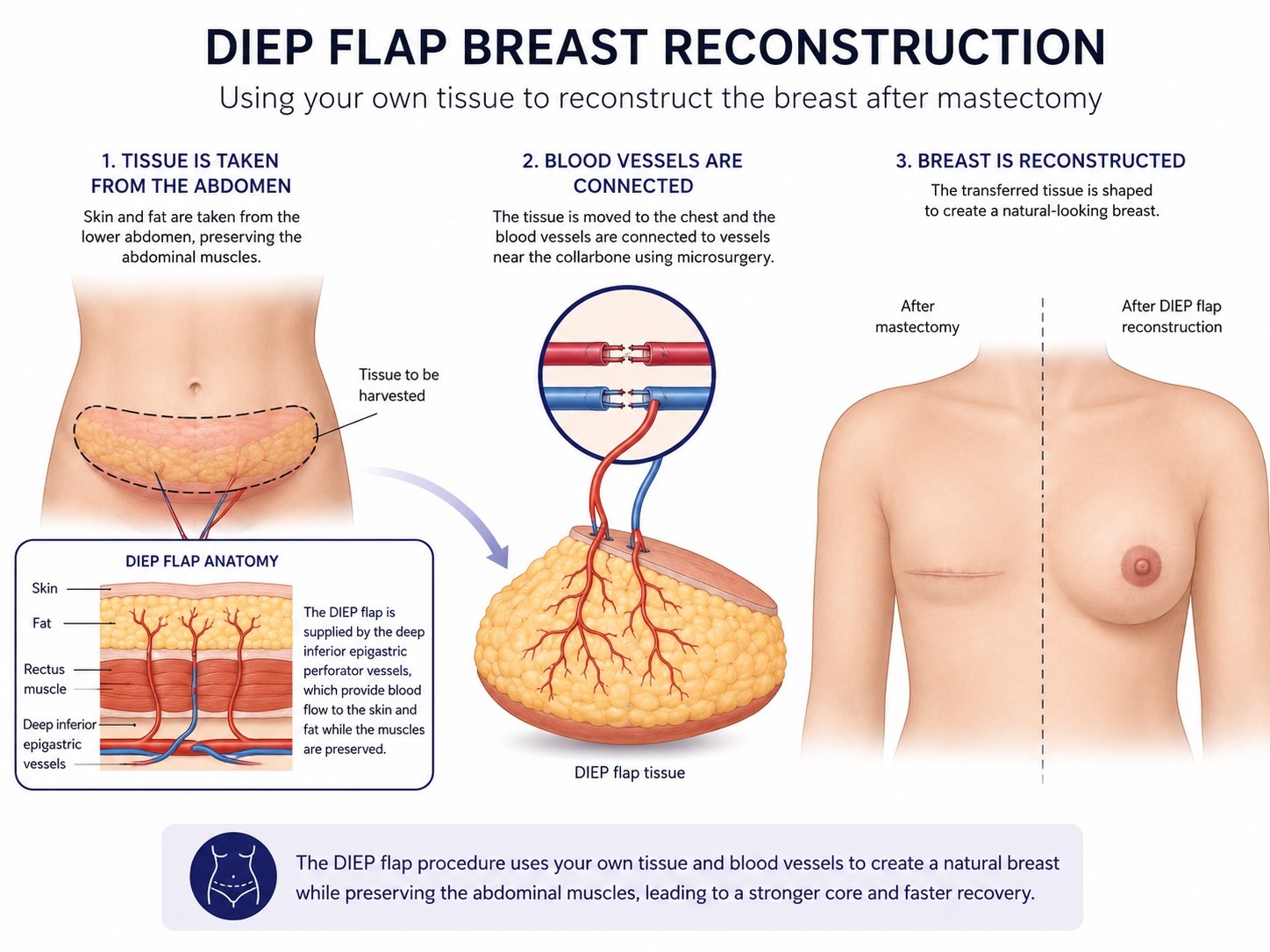
DIEP stands for deep inferior epigastric perforator. In a DIEP flap procedure, skin and fat from the lower abdomen are removed and transferred to the chest to create a new breast. The blood supply to the tissue (the deep inferior epigastric vessels) is carefully preserved and reconnected to vessels in the chest using microsurgery.
The DIEP flap is widely regarded as the gold standard of autologous reconstruction because it does not sacrifice the abdominal muscle, which means core strength is preserved. The surgery takes approximately 6 to 8 hours and requires a hospital stay of 4 to 6 nights. Recovery is longer than implant reconstruction, typically 6 to 10 weeks before returning to light activity.
Because autologous tissue ages naturally with your body, the results of DIEP flap reconstruction tend to be very long-lasting and feel more natural than implants. The technique is particularly well suited to larger breast sizes where it would be difficult to achieve symmetry with an implant alone.
Other autologous options
- LD flap (latissimus dorsi flap): tissue from the back, including the latissimus dorsi muscle, is brought forward to the chest. This is sometimes combined with an implant to achieve the desired volume. Recovery is shorter than DIEP, but the technique involves a scar on the back.
- TRAM flap: uses abdominal tissue including muscle. Less commonly used now that DIEP flap is established, as the DIEP approach preserves the abdominal muscles.
How do you decide which type of reconstruction is right for you?
There is no single formula for this decision. In my experience, the most common concern at this point is that patients worry they might choose the wrong option, and a second opinion is always a reasonable step if you want one. What I want to reassure you is that both implant-based and autologous reconstruction can produce excellent results in the right patient. The decision is about finding the right fit for your individual circumstances.
The factors that influence the choice include:
- Whether you will need radiotherapy, which may affect suitability for immediate implant reconstruction
- Your body shape and the volume of tissue available for a flap
- The size of the breast being reconstructed
- Your overall health and fitness for a longer operation
- Your personal feelings about scars, recovery time and the use of implants
- Whether reconstruction is to be immediate or delayed
The comparison table below gives an at-a-glance overview of the two main approaches:
| Implant-based reconstruction | DIEP flap reconstruction | |
|---|---|---|
| Procedure length | 1 to 3 hours (expander) or 2 to 4 hours (direct implant) | 6 to 8 hours (microsurgery) |
| Hospital stay | 1 to 2 nights | 4 to 6 nights |
| Recovery | 4 to 6 weeks before return to light activity | 6 to 10 weeks; donor site healing adds time |
| Longevity | Implants may need replacing after 10 to 20 years | Results are long-lasting; tissue ages naturally |
| Scarring | Scar at mastectomy site only | Mastectomy scar plus abdominal donor scar |
| Best suited for | Slimmer frame, preference for shorter surgery; post-radiotherapy may carry higher risk | Larger cup size, previous implant failure, desire for natural tissue, concerns about implants |
| Sensation | Limited return of sensation in most cases | Some return of sensation possible over time |
These differences are discussed in detail during your consultation. Reconstructive decisions are never made in isolation, and they are always made in collaboration with your oncology team to ensure the plan supports your cancer treatment first and foremost.
If you are facing a mastectomy and want to understand your reconstruction options, or have already had a mastectomy and want to discuss delayed reconstruction, Mr Ghosh offers private consultations at Harley Street Breast Care.
What does breast reconstruction surgery involve?
The specific steps of your surgery will depend on the technique chosen. There are, however, some elements common to all reconstruction procedures.
All breast reconstruction is carried out under general anaesthetic. You will be admitted to hospital on the day of surgery or the evening before, and before the procedure you will meet your anaesthetist and have the opportunity to ask any final questions.
Surgical markings are made while you are standing, which helps achieve the best possible symmetry.
Implant-based surgery
If you are having a tissue expander placed at the time of mastectomy, the procedure adds approximately 1 to 2 hours to the overall mastectomy time. The expander is placed in a pocket under the pectoralis major muscle, or under the skin with mesh support. Drainage tubes are placed during the operation and usually removed 1 to 3 days after surgery.
The expansion process begins a few weeks after surgery. Saline is added to the expander at regular clinic appointments until the desired volume is reached. The second operation to exchange the expander for a permanent implant is performed under general anaesthetic and usually requires 1 to 2 nights in hospital.
DIEP flap surgery
DIEP flap surgery is performed by a specialist microsurgeon and typically takes 6 to 8 hours. The lower abdominal tissue is carefully raised, preserving the deep inferior epigastric blood vessels, which are then connected to blood vessels in the chest under a microscope. Drain tubes are placed at both the chest and the donor site on the abdomen. Most patients require 4 to 6 nights in hospital.
Nipple and areola reconstruction, if desired, is generally performed as a separate minor procedure once the breast mound has fully settled, usually 4 to 6 months after the main reconstruction. Medical tattooing can be used to recreate the areola colour.
Recovery after breast reconstruction
Recovery time varies considerably depending on the technique used and your individual health. The figures below are general guidance and your care team will provide you with a personalised recovery plan.
Implant-based reconstruction
- Hospital stay: 1 to 2 nights for immediate reconstruction, and 1 to 2 nights for the implant exchange procedure
- Return to light daily activities: approximately 4 weeks
- Return to desk-based work: 4 to 6 weeks
- Return to driving: when you can perform an emergency stop comfortably, typically 4 to 6 weeks
- Strenuous exercise: 8 to 12 weeks, and your surgeon will advise
- Final result visible: 3 to 6 months after the last procedure
DIEP flap reconstruction
- Hospital stay: several nights
- Return to light daily activities: 6 to 8 weeks
- Return to desk-based work: 6 to 10 weeks
- Return to driving: typically 6 to 8 weeks
- Strenuous exercise: 3 to 4 months
- Donor site (abdomen): takes several weeks to heal, and the scar usually sits below the bikini line
- Final result visible: 12 to 18 months after surgery
During recovery you will be seen regularly in clinic to monitor healing and the progress of your result. If you are having adjuvant treatment such as chemotherapy, the timing of surgery is planned carefully to minimise any impact on your treatment schedule.
Risks and realistic expectations
All surgery carries risk, and breast reconstruction is no exception. It is important that you have a clear and honest picture of what to expect.
General surgical risks (all reconstruction types)
- Bleeding and haematoma
- Infection
- Wound healing problems, particularly in patients who have had radiotherapy or who smoke
- Anaesthetic complications
- Deep vein thrombosis (DVT) and pulmonary embolism, and you will be given preventative medication and compression stockings
Implant-specific risks
If you already have implants and are experiencing problems, see our guidance on breast implant issues.
- Capsular contracture: scar tissue forming around the implant causing firmness, distortion or discomfort
- Implant rupture or deflation
- Implant displacement or rotation
- Rippling (visible implant edges through skin)
- Breast implant-associated anaplastic large cell lymphoma (BIA-ALCL): a very rare type of lymphoma associated with textured implants, and smooth implants are now preferred in most cases
- Need for further surgery to replace or remove the implant
DIEP flap-specific risks
- Partial or total flap loss: very rare but serious, and the blood supply to the flap is carefully monitored in the first 48 hours after surgery
- Donor site complications: wound healing issues, seroma, weakness (less likely with DIEP than TRAM)
- Abdominal scar
- Hernia at donor site: uncommon with DIEP technique
Realistic expectations
A reconstructed breast will look different from your natural breast.
Scars will fade over 12 to 24 months but will not disappear, and sensation in the reconstructed breast may be significantly reduced or absent, though some patients report gradual improvement over the years following surgery, particularly with autologous reconstruction.
Asymmetry between the reconstructed and natural breast is common, and many patients opt for a minor procedure to the opposite breast to improve balance.
Revision surgery is a normal part of the reconstructive journey, not a sign that something has gone wrong.
The final result is typically assessed at 12 to 18 months, at which point any refinements can be discussed.
Frequently asked questions
Can I have breast reconstruction at the same time as my mastectomy?
Yes. Immediate breast reconstruction takes place under the same anaesthetic as your mastectomy. It is a common and well-established approach. However, it is not suitable for everyone, and in particular, if you are likely to need radiotherapy after surgery, your team may recommend delaying reconstruction until treatment is complete, as radiotherapy can affect both implants and flap tissue.
Does breast reconstruction affect my cancer treatment or the risk of recurrence?
No. Extensive evidence shows that breast reconstruction does not increase the risk of breast cancer recurrence and does not interfere with the ability to detect a recurrence. Your oncology team will always be involved in the timing of reconstruction to ensure it fits safely within your cancer treatment plan.
How long does breast reconstruction take to heal?
Recovery depends on the technique used. Implant-based reconstruction typically requires 4 to 6 weeks before returning to light activity. DIEP flap reconstruction involves a longer recovery of 6 to 10 weeks, with the donor site on the abdomen adding additional healing time. Final results take 12 to 18 months to fully settle.
Will I have sensation in my reconstructed breast?
Sensation in a reconstructed breast is often altered or reduced. Mastectomy severs the nerves that provide sensation to the breast, and while some sensation can return over time, particularly with autologous reconstruction, it is rarely the same as before. Many patients notice gradual improvement over the first two to three years following surgery. Nerve repair techniques are an area of ongoing development.
What is the difference between DIEP flap and implant reconstruction?
Implant-based reconstruction uses a silicone or saline implant to recreate the breast mound. It is a shorter operation with a faster initial recovery, but implants may need replacing over time and carry a higher risk of complications after radiotherapy. DIEP flap reconstruction uses your own abdominal tissue and produces a natural result that ages with you. It is a longer, more complex operation with a more involved recovery, but the results are very long-lasting.
Is breast reconstruction available on the NHS?
Yes. Breast reconstruction following mastectomy for cancer is available on the NHS. Access and waiting times vary by region. Some patients choose to have reconstruction privately to benefit from reduced waiting times, greater choice of technique and continuity of care with their chosen surgeon. Mr Ghosh operates privately at The London Clinic, The Harley Street Clinic and the Royal Free London.
How many operations will I need?
The total number of procedures depends on the technique chosen and your individual circumstances. Implant-based reconstruction involving a tissue expander requires at least two operations (expander placement, then implant exchange). DIEP flap reconstruction can often be completed in a single main procedure, followed by nipple and areola reconstruction as a separate minor step if desired. Many patients also have minor refinements at 12 to 18 months.
What happens to the other breast?
Achieving symmetry between a reconstructed breast and the natural breast can be challenging. Many patients opt for a procedure to the opposite breast, such as a reduction, uplift or augmentation, to improve balance. This is entirely your decision and is discussed during your consultation. Some patients undergoing risk-reducing mastectomy choose to have both breasts reconstructed at the same time.
How long will a reconstructed breast last?
Autologous (flap) reconstruction using your own tissue is intended to be permanent. The tissue ages naturally with your body and does not require replacement. Implants have a finite lifespan of typically 10 to 20 years, so further surgery may be needed at some point. Your surgeon will give you a clear picture of likely longevity at your consultation.
Am I too old for breast reconstruction?
Age alone is not a barrier to reconstruction. Suitability is assessed based on overall health, fitness for anaesthetic and the specific technique being considered. Implant-based reconstruction carries a lower physiological demand than DIEP flap surgery and may be more appropriate for some older patients. A consultation with Mr Ghosh will establish which options are suitable for you.
About your surgeon

Mr Debashis Ghosh
Consultant Breast & Oncoplastic Surgeon
Founder & Lead Surgeon
MS · FRCS (Edin) · FRCS (Intercollegiate)
FEBS (Breast) · FEBS (Surgical Oncology)
GMC No. 4657664
One of the UK’s most distinguished breast and oncoplastic surgeons
Mr Debashis Ghosh is recognised internationally as a leader in breast cancer treatment, reconstruction and oncoplastic surgery. He is dual-qualified by the European Board of Surgery in both Breast Surgery and Surgical Oncology, a distinction held by very few surgeons in Britain, and brings a rare combination of oncological precision and surgical craft to every patient he sees.
Founder and Lead Surgeon at Harley Street Breast Care, Mr Ghosh was formerly Clinical Director of Breast Services for NHS England (NCL Cancer Alliance). He is Divisional Director at The London Clinic and Co-Chair of the specialist MDT at The Harley Street Clinic, where complex cases from across the UK and internationally are reviewed by leading oncologists, pathologists and radiologists.
He pioneered the use of the portable gamma camera for sentinel node biopsy in the UK and is a published co-author of the breast and oncoplastic surgery chapter in Kirk’s Operative Surgery, the definitive surgical textbook. His One Stop Breast Clinic delivers consultation, imaging, biopsy and same-day results in a single visit, so patients are never left waiting weeks for answers.
Mr Ghosh sees private patients at 146 Harley Street, The London Clinic, The Harley Street Clinic and the Royal Free London. Insured and self-funding patients are welcome.
Royal Free London
The London Clinic
The Harley Street Clinic
UCL Medical School
Ready to discuss your breast reconstruction options?
Mr Ghosh provides expert, compassionate consultations at Harley Street Breast Care. Whether you are planning ahead before mastectomy or considering delayed reconstruction, he will guide you through every option in full.
Sources
- BAPRAS (British Association of Plastic, Reconstructive and Aesthetic Surgeons). Breast Reconstruction. bapras.org.uk
- NHS. Mastectomy. nhs.uk
- NICE. Early and locally advanced breast cancer: diagnosis and management (NG101). nice.org.uk
- Breast Cancer Now. Breast reconstruction. breastcancernow.org
- MHRA. Breast implant associated anaplastic large cell lymphoma (BIA-ALCL). gov.uk
This article is for informational purposes only and does not constitute medical advice. If you have concerns about breast cancer treatment or reconstruction options, please consult a qualified medical professional.